

Steel and Betrayal: The Hundred Years’ War in 1424 and the Battle of Verneuil
By 1424, the Hundred Years’ War had entered one of its most volatile and brutal phases—what historian Desmond Seward aptly called “a war without honor, in which no side could claim a monopoly on virtue or villainy.” England, emboldened by its shattering victory at Agincourt in 1415, sought to complete what had become, over the generations, a dynastic and existential conquest. France, fractured by civil war, betrayal, and madness, looked not toward a single king but two. And into this crucible rode a third player—the Scots—who would meet their fate on the blood-soaked fields of Verneuil in August 1424.
The origin of this phase was as much political as it was military. After Agincourt, Henry V of England pursued not simply military victories, but a legal claim to the French throne. In 1420, the Treaty of Troyes named him heir to Charles VI of France, bypassing the Dauphin, Charles VII. It was a political masterstroke backed by arms and sealed by Henry’s marriage to Charles’s daughter, Catherine. But in 1422, Henry died unexpectedly of dysentery at just 35. A nine-month-old infant, Henry VI, was now King of England—and, on paper, of France.
In reality, France remained divided. The English held Normandy and much of northern France, backed by the Burgundians, while the Dauphin clung to the Loire and southern heartlands. The vacuum left by Henry’s death presented a fleeting chance for the French to retake ground. Into this opportunity stepped their oldest allies—the Scots.
Bound by the Auld Alliance since 1295, Scotland saw an opening to strike at its southern enemy. In 1423, a new Scottish army of approximately 7,000 men crossed into France under the command of John Stewart, Earl of Buchan, and Archibald Douglas, 4th Earl of Douglas, Scotland’s most formidable warlord. For a brief moment, it seemed history might turn in France’s favor. “Scotland did not send auxiliaries,” notes Jonathan Sumption, “but a full army with ambitions of deciding the war” (The Hundred Years War, Vol. IV, 2015, p. 264).
In August 1424, this army, now reinforced by French troops, marched into Normandy, aiming to take back the fortress town of Verneuil-sur-Avre. The English response was swift. John, Duke of Bedford—Henry V’s brother and regent of France—marched with 9,000 men to confront the invaders. His force, hardened by years of campaign, included English longbowmen, men-at-arms, and Burgundian cavalry.
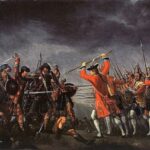
The armies met on 17 August 1424, just outside Verneuil. What followed was one of the bloodiest and most decisive battles of the entire Hundred Years’ War. The Scots, in the center, initially pushed back the English vanguard. But Bedford, demonstrating a ruthless tactical brilliance, ordered a flanking attack and a renewed archery barrage. The Scottish formation broke under pressure. Douglas and Buchan were both killed, alongside over 6,000 Scots—a catastrophe that rivaled Flodden or Halidon Hill in scope. “The battle,” wrote the French chronicler Enguerrand de Monstrelet, “was so cruel and mortal that none had seen the like in a hundred years” (Chroniques, c. 1450).
The English suffered heavy losses but held the field. Verneuil was a strategic and psychological triumph for Bedford. It shattered the Scottish military presence in France and extinguished the hope that French resistance might be reinforced from abroad. “Verneuil was Agincourt’s grim twin,” observes Juliet Barker, “less famous, but no less deadly” (Conquest: The English Kingdom of France, 2009, p. 153). It also solidified Bedford’s dominance in northern France, keeping the Anglo-Burgundian alliance intact and reinforcing the illusion of an English-controlled France.
Politically, the aftermath was murkier. The Dauphin Charles VII continued to claim the French crown, despite the setback. The Scots—though devastated—would eventually send more troops to aid the French cause, most famously under the future Joan of Arc. But in the short term, Verneuil ended any realistic hope of a quick reversal of English gains.
For Scotland, the consequences were profound. The deaths of Douglas and Buchan created a power vacuum, and the cream of its military elite had been annihilated on foreign soil. The loss severed the high-water mark of Scottish influence in Europe. “It was,” writes Michael Brown, “a noble gesture paid for in lives, with nothing to show but graves in foreign fields” (The Black Douglases, 1998, p. 211).
Verneuil, then, was not just another battle—it was the closing act of a strategy, a final English victory in the high medieval style, after which the war would slowly evolve into a war of sieges, supply lines, and irregular resistance. It marked the end of the chivalric phase of the Hundred Years’ War, a time when noble armies met in set-piece battle under banners and saints.
William Manchester once wrote that “wars are remembered less for what they accomplish than for what they destroy.” In 1424, Verneuil destroyed illusions—of Scottish military ascendancy, of French unity, and of English invincibility. It left only what war always leaves: scorched fields, broken armies, and a new chapter written in blood.
References:
- Sumption, Jonathan. The Hundred Years War, Vol. IV: Cursed Kings. Faber & Faber, 2015.
- Barker, Juliet. Conquest: The English Kingdom of France in the Hundred Years War. Abacus, 2009.
- Brown, Michael. The Black Douglases: War and Lordship in Late Medieval Scotland, 1300–1455. Tuckwell Press, 1998.
- Monstrelet, Enguerrand de. Chroniques, c. 1450, trans. J. Colville, 1840.
- Seward, Desmond. The Hundred Years War: The English in France, 1337–1453. Penguin, 1999.