
Malcolm III (1058–1093): The King Who Redefined Scotland
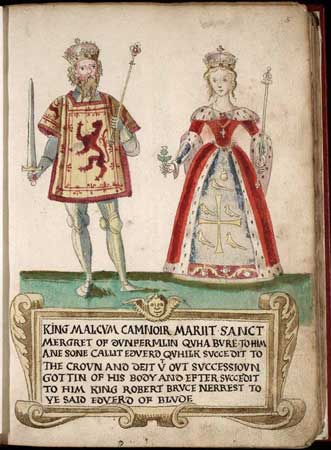
The reign of Malcolm III (Máel Coluim mac Donnchada), from 1058 to 1093, marked a profound shift in the political and cultural trajectory of Scotland. Malcolm III, also known as Malcolm Canmore (Cenn Mór, meaning “Big Head” or “Great Chief”), inherited a fractured and vulnerable kingdom in the wake of dynastic conflict and Viking incursions. His reign represented a pivotal moment in Scottish history as he consolidated royal authority, redefined Scotland’s relationship with Anglo-Saxon England, and laid the foundations for a more centralized and feudal Scottish state.
Malcolm’s rise to power was rooted in his claim to the House of Alpin through his father, Duncan I (Donnchad mac Crínáin), whose death at the hands of Macbeth in 1040 had plunged Scotland into political instability. Malcolm’s eventual victory over Macbeth’s successor, Lulach, in 1058 ended the political dominance of the House of Moray and initiated the establishment of a hereditary monarchy based on primogeniture rather than the older Gaelic system of tanistry. Malcolm’s marriage to Margaret of Wessex, an Anglo-Saxon princess, further aligned Scotland with the emerging feudal order of medieval Europe and introduced new religious and political reforms that shaped the future of the Scottish crown.
Malcolm III’s long and complex reign was defined by both success and failure. He expanded Scotland’s territorial influence and reinforced the authority of the crown, but his repeated invasions of England ultimately exposed Scotland’s military weakness and led to the devastating defeat at Alnwick in 1093, where Malcolm was killed. As historian Michael Lynch observes, “Malcolm III was the first truly medieval king of Scotland—a ruler who transformed the crown from a Gaelic chieftaincy into a European monarchy, even as his military ambitions revealed the limits of Scottish power” (Lynch, 1991).
The Rise of Malcolm III and the Political Context of His Reign
Malcolm III was born around 1031 as the eldest son of Duncan I (Donnchad mac Crínáin) and Sibyl, a daughter of the Anglo-Saxon nobleman Siward, Earl of Northumbria. His father’s reign (1034–1040) was the first in Scottish history based on primogeniture—direct inheritance from father to son—rather than the traditional Gaelic system of tanistry, where the throne passed to the most capable male of the royal line.
Duncan’s attempt to impose this new model of succession was met with resistance from the Gaelic nobility and the powerful mormaers of Moray. In 1040, Duncan was defeated and killed in battle by Macbeth at Pitgaveny near Elgin. Macbeth ruled Scotland for 17 years, stabilizing the kingdom through political alliances and military strength.
Malcolm fled to England after his father’s death, where he was sheltered at the court of Edward the Confessor. There, Malcolm was exposed to the emerging Anglo-Norman political order and formed close ties with the Anglo-Saxon aristocracy. These connections would later define his political strategy as king.
In 1057, Malcolm invaded Scotland with the backing of Edward the Confessor. He confronted Macbeth at the Battle of Lumphanan and killed him, but Macbeth’s stepson, Lulach, was crowned king with the support of the Gaelic nobility. Malcolm defeated Lulach at the Battle of Essie in 1058, ending the political dominance of the House of Moray and establishing himself as King of Scots.
Alex Woolf describes Malcolm’s rise as “the triumph of a new political order—a victory for a centralized monarchy based on primogeniture and Anglo-Norman political influence over the older Gaelic system of kingship” (Woolf, 2007).
Political and Military Challenges
1. Consolidation of the Scottish Crown
Malcolm’s first task as king was to secure his authority over the fragmented kingdom of Alba. While the defeat of Lulach ended the immediate threat from Moray, the mormaers of Atholl, Ross, and Strathclyde retained considerable political autonomy.
Malcolm reinforced his political authority through a combination of military campaigns and strategic marriages. He secured the loyalty of the mormaers by granting them land and political titles in exchange for military service.
Malcolm also sought to reinforce the influence of the Scottish Church as a pillar of royal authority. He promoted the influence of the Benedictine order and aligned the Scottish Church more closely with the Roman Catholic tradition. This shift marked the beginning of the decline of the older Celtic Christian tradition in favor of a more centralized, European-style ecclesiastical structure.
Michael Lynch notes that “Malcolm III’s consolidation of the Scottish crown was achieved through calculated diplomacy and political pragmatism—his willingness to embrace feudal and religious reforms ensured that his authority extended beyond the Gaelic heartlands” (Lynch, 1991).
2. Anglo-Saxon Influence and the Marriage to Margaret of Wessex
Malcolm’s most significant political move was his marriage to Margaret of Wessex in 1070. Margaret was the sister of Edgar Ætheling, the last Anglo-Saxon heir to the English throne. After the Norman Conquest of 1066, Margaret and her family sought refuge in Scotland.
Margaret was a devout Christian and a powerful political influence on Malcolm’s court. She introduced Anglo-Norman customs, strengthened ties between the Scottish crown and the Papacy, and promoted religious reforms that aligned the Scottish Church with European Catholicism.
Margaret also acted as a cultural bridge between the Gaelic and Anglo-Saxon traditions within Scotland. Her influence led to the adoption of Anglo-Norman names, dress, and customs at the Scottish court.
Richard Oram writes that “Margaret’s influence on Malcolm’s court introduced a new political and cultural order in Scotland—her reforms shaped the monarchy’s transition from a Gaelic kingdom to a European state” (Oram, 2011).
3. Conflict with the Norman Kingdom of England
Malcolm’s relationship with England was defined by both alliance and conflict. While his marriage to Margaret strengthened ties with the Anglo-Saxon aristocracy, the Norman conquest of England in 1066 introduced a new political reality.
William the Conqueror’s expansionist ambitions brought Malcolm into direct conflict with the Norman crown. Malcolm invaded Northumbria in 1070, 1079, and 1091**, seeking to extend Scottish control over northern England.
Malcolm’s campaigns were met with mixed success. His early raids secured short-term gains, but William’s forces eventually repelled the Scottish advances. Malcolm’s most ambitious invasion in 1093 ended in disaster at the Battle of Alnwick, where Malcolm was ambushed and killed.
Alex Woolf argues that “Malcolm’s military ambitions exposed the limits of Scottish power—his death at Alnwick reflected the growing imbalance between the emerging Norman state and the smaller Scottish kingdom” (Woolf, 2007).
Setbacks and the Fall of Malcolm III
Malcolm III’s death at Alnwick was a catastrophic blow to the Scottish monarchy. His eldest son, Edward, was also killed in the battle. Malcolm’s death created a political vacuum that led to internal conflict over the succession.
Margaret died three days after Malcolm’s death, reportedly from grief. Her death removed a stabilizing influence from the Scottish court and left Malcolm’s surviving sons vulnerable to political intrigue.
Michael Lynch observes that “Malcolm III’s death symbolized both the height of Scottish power and the fragility of its political structure—the emergence of a new order was accompanied by the threat of internal and external instability” (Lynch, 1991).
Accomplishments and Legacy
1. Political Consolidation
Malcolm’s defeat of Macbeth and Lulach established a centralized monarchy based on primogeniture.
2. Cultural Transformation
Margaret’s influence introduced Anglo-Norman customs, religious reforms, and political practices into Scotland.
3. Expansion and Military Failure
Malcolm’s military campaigns in England demonstrated Scotland’s ambitions but also exposed its military weakness.
References
- Barrow, G.W.S. (1981). Kingship and Unity: Scotland, 1000–1306. Edinburgh University Press.
- Lynch, Michael. (1991). Scotland: A New History. Pimlico.
- Woolf, Alex. (2007). From Pictland to Alba, 789–1070. Edinburgh University Press.
- Oram, Richard. (2011). The Kings and Queens of Scotland. Tempus Publishing.