
Andrew Moray (d. 1297): The Forgotten Commander of Scotland’s First Victory
History, as William Manchester would have agreed, too often favors the louder name. In the struggle for Scottish independence, that name is William Wallace—immortalized in legend and film. Yet beside him at the Battle of Stirling Bridge in 1297, in equal command and likely equal genius, stood Andrew Moray—a name too often lost in the fog of heroic mythmaking. If Wallace was the heart of the resistance, Moray was its mind: a noble-born tactician from the north, who lit the spark of rebellion before Wallace ever took the field. His death following Stirling robbed Scotland of one of its most capable early military leaders, a man whose brief but critical campaign shook Edward I’s illusion of dominance and helped set the course for a nation’s survival.
Andrew Moray was born into the influential Moray family of Petty, near Inverness—a region remote from the royal power centers but rich in feudal tradition and strategic significance. His father, also named Andrew, was Justiciar of Scotia and a prominent figure in the northern nobility. When Edward I of England invaded Scotland in 1296, deposing King John Balliol and occupying the realm, young Moray was taken as a prisoner and held in Chester. By the following spring, he had escaped—possibly with the aid of sympathizers—and returned to his ancestral lands, where he immediately began organizing resistance in Moray and Ross.
While Wallace was still conducting guerrilla raids in the south, it was Moray who launched the first coordinated rebellion in the north. By the summer of 1297, he had captured English-held castles—including Urquhart and Inverness—and rallied support among Highland clans and Norman-Scots barons. “Moray’s insurrection,” wrote historian Colm McNamee, “was both better organized and more widespread than Wallace’s at that stage. He was the first to fight as though Scotland were still a kingdom worth reclaiming” (McNamee, The Wars of the Bruces, 1997).
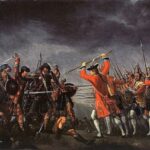
The convergence of Moray’s forces with Wallace’s in central Scotland marked a turning point in the rebellion. Far from being Wallace’s subordinate, Moray co-commanded the combined army. The two leaders shared strategy and authority, though the mythos that later grew around Wallace would eclipse Moray’s crucial role. On September 11, 1297, at the Battle of Stirling Bridge, Moray and Wallace took a bold gamble: allowing the numerically superior English army, under John de Warenne, to partially cross the narrow bridge before striking. Trapped between river and Scottish spears, the English were decimated. “It was Moray’s deep knowledge of the terrain and his sense of timing,” noted Fiona Watson, “that turned what might have been a symbolic clash into a decisive blow against English rule” (Watson, Under the Hammer, 1998).
The victory at Stirling was stunning. It shattered English morale and revived Scottish hopes. The Guardian of the Realm was dead; but a resistance was alive. For the first time since Balliol’s deposition, a Scottish army had triumphed in the field—and done so through cunning, discipline, and unity. Wallace’s name surged into legend, but Moray paid the price for the victory. Wounded during the battle—some accounts suggest a lance injury—he died of his injuries weeks later, likely in October 1297.
His death was a profound blow. Moray’s northern connections, political moderation, and noble status made him a unifying figure in a rebellion largely led by men from the margins of power. Without him, Wallace found himself isolated among the magnates, his influence over the nobility limited. “Had Moray lived,” wrote G.W.S. Barrow, “the history of the Scottish resistance might have unfolded very differently—perhaps with greater cohesion and less tragic fragmentation” (Barrow, Robert Bruce and the Community of the Realm of Scotland, 1988).
Though his military career was brief, Andrew Moray’s legacy was foundational. He proved that English domination could be challenged not by brute force alone but through tactical brilliance and regional mobilization. His early successes in the north inspired a broader uprising and gave Wallace the momentum needed to carry the rebellion forward. Stirling Bridge, often remembered for its theatrical slaughter, was also a masterpiece of field command—and Moray’s fingerprints were all over it.
Scotland, in the long shadow of its national story, eventually remembered Moray. His son, Sir Andrew Murray, would become Guardian of Scotland himself, fighting alongside Robert the Bruce and continuing the struggle his father had begun. In this way, Moray’s legacy outlived his name, passed down not in song but in statecraft. He was a soldier who refused surrender, a noble who stood with commoners, and a strategist who carved Scotland’s first path back to freedom.
References
- Barrow, G.W.S. Robert Bruce and the Community of the Realm of Scotland. Edinburgh University Press, 1988.
- McNamee, Colm. The Wars of the Bruces: Scotland, England and Ireland, 1306–1328. Tuckwell Press, 1997.
- Watson, Fiona. Under the Hammer: Edward I and Scotland, 1286–1307. Tuckwell Press, 1998.
- Penman, Michael. Robert the Bruce: King of the Scots. Yale University Press, 2014.
- Duncan, A.A.M. The Kingship of the Scots. Edinburgh University Press, 2002.