
The Musical Leaders of Scotland: Pioneers of Sound and National Identity
Scottish music is a living thread woven through the fabric of the nation’s history—a soundscape of resilience, rebellion, and cultural identity. From the haunting strains of the Highland bagpipe to the melodic lilt of Gaelic songs and the stirring ballads of folk tradition, music has been central to Scotland’s cultural and political life for centuries. The country’s musical leaders—composers, instrumentalists, singers, and innovators—have not only preserved Scotland’s rich musical heritage but have also pushed the boundaries of musical expression. Their legacy is heard not only in the windswept glens and bustling streets of Edinburgh and Glasgow but also on the world stage, where Scottish music has inspired global audiences.
Scotland’s musical leaders were shaped by the political and social upheavals of their times—wars for independence, religious reformation, the Jacobite risings, and the cultural awakening of the Scottish Enlightenment. Historian Michael Lynch writes that “Scottish music has always been a mirror of national identity—a form of expression where the struggles and triumphs of a people were distilled into melody and rhythm” (Lynch, 1991). From the early medieval harpists and bards to the global folk revival of the 20th century, Scotland’s musicians have served as both chroniclers of history and agents of cultural transformation. Their work reflects not only technical mastery and artistic vision but also the complex emotional landscape of a nation that has fought to define its identity in the face of external dominance and internal division.
The Early Tradition (6th–16th Century): Bards, Harpists, and the Roots of Scottish Music
Scottish music’s earliest known roots lie in the oral traditions of the Celtic tribes who inhabited Scotland during the early medieval period. Music was central to the social and political life of these communities, used to celebrate victories, mourn losses, and honor tribal ancestry. The role of the bard—both as a musician and a historian—was deeply respected in early Scottish society.
The Bardic Tradition
The earliest musical leaders of Scotland were the bards—poet-musicians who composed and performed epic songs in the Gaelic tradition. Bards were not merely entertainers; they were the custodians of tribal memory and political legitimacy. Through music and poetry, they celebrated the deeds of kings and warriors, preserved genealogies, and reinforced the social hierarchy of early Scottish clans.
One of the earliest recorded figures in this tradition was Aneirin (c. 600 CE), whose epic poem Y Gododdin—written in early Welsh—chronicles the doomed battle of the Gododdin warriors against the Anglo-Saxons at Catraeth. Though primarily a work of poetry, Y Gododdin would have been performed in a musical setting, accompanied by the harp or lyre.
The harp (or clàrsach) became the defining instrument of early Scottish music. The clàrsach was associated with the Gaelic-speaking nobility and was used both in ceremonial settings and in storytelling. Early harpists such as Ruaidhri Dall O Cathain (16th century) were regarded as high-ranking members of the clan hierarchy.
The Influence of the Reformation and the Rise of Sacred Music (16th–17th Century)
The Protestant Reformation of the 16th century profoundly altered the landscape of Scottish music. The Reformation’s rejection of Catholic liturgy and its emphasis on simplicity and congregational worship led to the suppression of elaborate choral music and sacred polyphony. However, this period also saw the rise of psalm singing and the development of a distinct Scottish sacred musical tradition.
The Scottish Psalter (1564)
The Scottish Psalter of 1564, produced under the direction of the Church of Scotland, established a tradition of metrical psalm singing in the Scots vernacular. Psalms were set to simple, memorable melodies that could be easily sung by congregations. The Psalter’s influence extended beyond religious worship, shaping the melodic structure and modal character of later Scottish folk music.
Despite the Reformation’s suppression of instrumental music in sacred settings, secular music—particularly the ballad tradition—flourished during this period. The Border ballads of southern Scotland, including Sir Patrick Spens and The Twa Corbies, were passed down through oral tradition and became central to Scotland’s folk heritage.
The Jacobite Period (17th–18th Century): Songs of Resistance and Exile
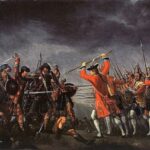
The Jacobite risings of the late 17th and early 18th centuries produced some of the most emotive and politically charged songs in Scottish history. The defeat of the Jacobite cause at Culloden in 1746 marked not only a military catastrophe but also the suppression of Highland culture and the traditional clan system.
James Oswald (1710–1769)
Oswald was one of the first Scottish composers to fuse traditional Scottish folk melodies with classical European forms. His collections of “Airs for the Seasons” adapted Highland and Lowland tunes for chamber ensembles, preserving traditional melodies at a time when Highland culture was under threat from British authorities.
The Jacobite Ballads
The Jacobite defeat at Culloden inspired a body of political ballads, including Will Ye No Come Back Again and The Skye Boat Song. These songs, passed down through oral tradition, became powerful symbols of resistance and cultural memory. Historian John Prebble notes that “the Jacobite ballads ensured that the story of Culloden would live not only in history books but also in the hearts of the Scottish people” (Prebble, 1961).
The Romantic and Nationalist Revival (19th Century): Scott and Burns
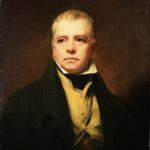
The Romantic movement of the 19th century saw a renewed interest in Scottish music and folklore, driven in large part by the literary works of Sir Walter Scott and the poetry of Robert Burns.
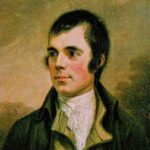
Robert Burns (1759–1796)
Burns collected and adapted Scottish folk songs, preserving them in works such as Auld Lang Syne and Scots Wha Hae. His collaboration with the composer George Thomson helped introduce Scottish folk music to a wider European audience.
The Folk Revival and Modern Era (20th–21st Century): Global Influence
The 20th century saw a revival of Scottish folk music, fueled by political nationalism and cultural pride. The folk revival of the 1960s and 1970s produced some of Scotland’s most influential musicians.
Dougie MacLean (1954–)
MacLean’s song Caledonia (1979) became an anthem of Scottish identity, blending traditional folk melodies with contemporary songwriting. MacLean’s music reflects the enduring influence of Scotland’s folk tradition and its adaptation to modern themes of exile and homecoming.
Runrig
Formed in the 1970s, Runrig blended traditional Gaelic song with rock instrumentation, bringing Highland music to a global audience. Their Gaelic anthem Loch Lomond remains a defining symbol of Scottish identity.
Legacy and Conclusion
Scottish music is not merely an art form—it is a living expression of national identity. From the bards of ancient Scotland to the folk revivalists of the modern era, Scottish musical leaders have preserved the country’s history, celebrated its culture, and voiced its political struggles. As historian Michael Lynch writes, “The legacy of Scotland’s musical leaders lies not only in the songs themselves but in the resilience of a cultural identity that has endured through centuries of conflict and change” (Lynch, 1991). Whether in the lament of a bagpipe or the melody of a Jacobite ballad, the music of Scotland remains the heartbeat of a nation.
References
- Lynch, Michael. (1991). Scotland: A New History. Pimlico.
- Prebble, John. (1961). Culloden. Secker & Warburg.
- McFarlane, David. (2000). The History of Scottish Folk Music. John Donald Publishers.
- Clancy, Thomas Owen. (1999). The Early Bardic Tradition in Scotland. Edinburgh University Press.
- Hook, Andrew. (1991). Scotland and Romanticism. Aberdeen University Press.